How Accommodations Are Determined
Disability Services at KAUST is committed to providing students with equal access to all aspects of university life.
The process of determining accommodations at KAUST is thoughtful and individualized. Our goal is to ensure that students with disabilities have equal access to academic and campus life while maintaining the integrity of our educational programs.
Documentation plays an important role in helping us understand the barriers you may be facing and in determining appropriate accommodations. However, you do not need to wait until your documentation is complete to speak with us. We encourage you to register with our office early in the process, even if you are still working on obtaining the required materials.
How Accommodations Are Determined
Step 1: Initial Assessment
We begin by confirming whether you are a current or incoming KAUST student and whether your situation meets the criteria for a disability. This determination is based on established legal definitions of disability and the documentation you provide. If you do not meet the criteria, we will do our best to refer you to other relevant campus resources that may be helpful.
Step 2: Impact Analysis
Next, we review the details you have submitted regarding your condition, including its symptoms, duration, frequency, severity, and how it is managed. This allows us to understand how your disability may affect your experience at KAUST and whether there are functional limitations that need to be addressed.
Step 3: Environment and Barrier Analysis
We then evaluate the specific KAUST environment in which you will study or live, including academic expectations, campus housing, and university policies. We are looking to identify any disability-related barriers that may prevent full participation or create unequal access. If no such barriers exist, then accommodations may not be necessary. Having a disability alone does not automatically result in approved accommodations.
Step 4: Accommodation Exploration
Finally, we consider reasonable accommodations that could address the identified barriers without fundamentally altering academic or program standards. Our team carefully reviews your request and may consult with faculty, housing, or other university offices to better understand the environment. In some cases, we may ask you for additional information or clarification.
Accommodations are approved when the evidence supports that a specific change to the environment is necessary to ensure your equal access to the opportunities offered at KAUST.
Why Documentation Matters
We use documentation to better understand how your disability affects your daily life and academic experience at KAUST. Our goal is to ensure that any accommodations we put in place are both relevant and effective in addressing the barriers you are experiencing.
You are welcome to meet with us before submitting documentation. We can discuss your needs, explain what kinds of documents may be helpful, and support you in accessing an appropriate evaluation or provider if needed.
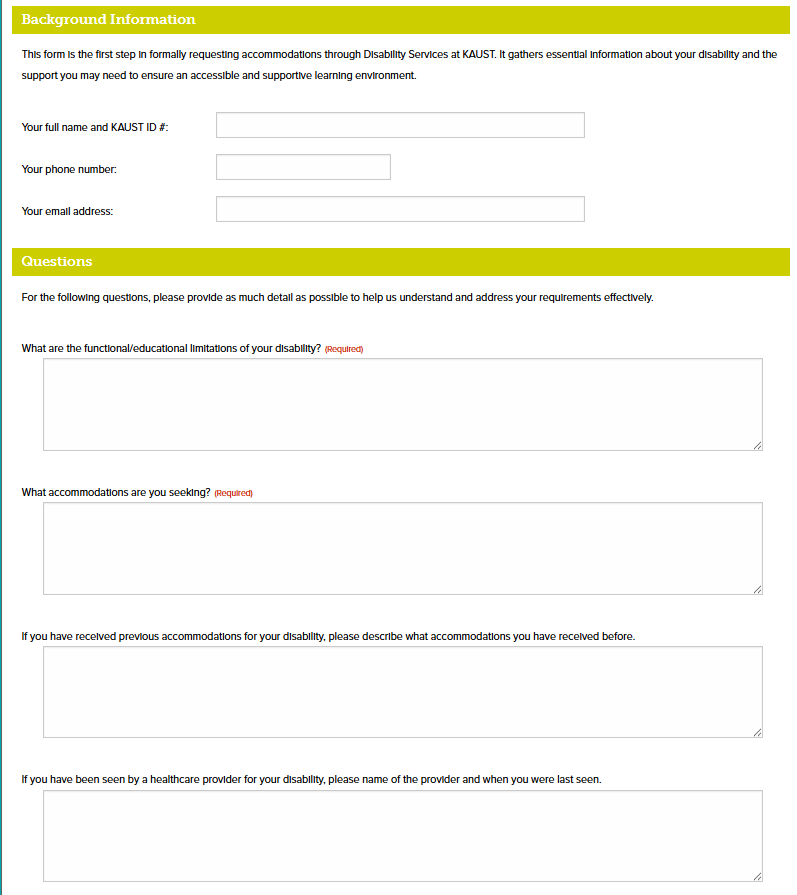
What Your Documentation Should Include
To help us evaluate your request, your documentation should ideally:
- Be from a qualified professional who is familiar with your condition
- Be typed on official letterhead and include a signature or stamp
- Clearly state a diagnosis (where applicable)
- Describe how the condition affects your daily functioning, particularly in an academic setting
- A statement about the expected course or prognosis of the condition, indicating whether it is stable, likely to improve, or may change over time and require future adjustments to accommodations
- Include a summary of any current treatment or supports you are using
- Recommend accommodations and explain how they relate to the difficulties you are experiencing
- Be recent enough to reflect your current functioning (typically within the last three years)
If your documentation is missing information or does not meet these standards, we will contact you to discuss next steps.
Examples of Helpful Documentation
The following documents can help us understand your needs. You may submit one or more of the following:
- A psychoeducational or neuropsychological evaluation
- A medical report or summary
- An audiology or vision assessment
- Records from a previous school that include accommodations (e.g., IEP, 504 Plan, or university support letters)
- Proof of accommodations on standardized exams (SAT, ACT, GRE, etc.)
- KAUST Disability Medical Documentation Form (for most medical or psychological conditions)
This is not a complete list. If you have other types of documentation that you believe are relevant, please let us know.

If You Do Not Yet Have Documentation
We understand that accessing documentation is not always easy. If you are in the process of obtaining an evaluation or face barriers to doing so, we still encourage you to connect with our office. We will listen to your concerns, explore ways we can support you in the meantime, and help you identify next steps.
Disability Services FAQs - Accommodation Decisions
Documentation requirements vary depending on the nature of the disability and the accommodations requested. In general, documentation should be provided by a qualified professional and clearly describe both the diagnosis (where applicable) and the functional impact of the condition, particularly in an academic setting. Documentation should also support the need for the requested accommodations and reflect your current level of functioning.
Documentation typically includes information about how the condition affects daily activities, any relevant treatment or supports, and whether the condition is stable or may change over time. Documentation should be recent enough to accurately reflect current needs. If documentation is incomplete or does not meet these guidelines, Disability Services will contact you to discuss next steps.
Documentation helps Disability Services understand how a disability affects a student’s access in specific contexts. It supports informed, consistent, and fair accommodation decisions, particularly when accommodations involve academic requirements, safety considerations, or resource planning.
No. Information shared with other KAUST services is not automatically shared with DS. If you would like us to have access to specific records, you must submit them directly using the registration or medical documentation upload forms.
Disability Services does not conduct diagnostic testing. However, we can guide you through the process and share information about testing providers.